
Innovation
A precision agriculture pilot site in coastal Kenya. Testing sensors, publishing results, proving what works for smallholder farms in challenging environments.
The Gap
Our first season proved two things: the land can produce, and the absence of monitoring cost us our primary cash crop. Every technology on this page exists to close a specific gap we have experienced first-hand.
Deployment Priority
1. Water Infrastructure
The single biggest constraint on the farm. We need a large underground water tank for irrigation storage — estimated at KES 500,000–800,000 depending on capacity. This removes our total dependence on rain-fed farming and makes a second annual crop cycle possible. A borehole is the longer-term goal but costs KES 1.8–2.3 million at Magarini drilling depths. Water comes before any sensor deployment because without it, the data is academic.
2. Weather Station
A solar-powered Davis Vantage Pro2 Plus with sonic anemometer ($2,500–$3,200, including the WeatherLink console/data logger required for connectivity and data export). The Plus package includes a solar radiation sensor — essential because evapotranspiration calculation depends on it. This gives us wind, rain, temperature, humidity, solar radiation, and ET data. The sonic anemometer has no moving parts, which matters in coastal salt air where mechanical bearings corrode in 1–2 years — and the corrosion concern extends beyond the anemometer to all outdoor equipment: connectors, solar panel frames, sensor housings, and cable terminations all degrade faster in salt-laden air. Lightning protection is part of the deployment plan: a Davis 7854 surge protector on the anemometer cable and a grounded copper earthing rod at the mast base, with all sensor cables routed through surge-protected junction boxes.
3. Soil Monitoring
We do not yet have a laboratory soil analysis — we are literally farming without knowing our soil type. The plan is a layered approach: periodic laboratory analysis at CropNuts (KES 8,000–15,000 per full test) for nutrients, organic matter, and soil classification — combined with continuous IoT sensors (Dragino LSE01, ~$150 per node, plus a LoRaWAN gateway at ~$150–200 as a one-time fixed cost) for moisture, temperature, and electrical conductivity. One important caveat: the LSE01’s EC reading is indicative, not lab-grade. In coastal soils with potential salinity, it is useful for tracking relative changes over time but should not be relied on for absolute salinity measurements — periodic laboratory analysis remains essential for ground truth. No affordable sensor reliably measures NPK directly, so we do not pretend one will.
4. Market Intelligence
Malindi’s wholesale market is 40 km away; Mombasa’s Kongowea market is roughly 120 km. We currently sell based on crop readiness rather than market readiness. The goal is systematic price tracking from both markets — starting with manual tracking via mobile, then progressing to automated collection as volume justifies it. Combined with harvest timing data, this builds a picture of when to plant and when to sell.
5. Data Analytics & Decision Support
Once sensor data is flowing, we plan to build lightweight analytics that correlate weather patterns, soil conditions, and market prices with yield outcomes. Not black-box predictions, but interpretable models where every recommendation can be traced back to the data that produced it. The first target: irrigation scheduling based on soil moisture trends and weather forecasts.
Site Infrastructure
Connectivity: Safaricom 4G and Airtel 4G are both confirmed at the farm site — sufficient for cellular IoT backhaul without needing satellite uplinks. A 1NCE IoT SIM (500 MB) covers the first 6–12 months of gateway traffic; a Safaricom M2M SIM takes over for long-term operation. Power: the farm is currently off-grid. A 40W solar panel, 12V 20–30Ah battery, and MPPT controller must sustain approximately 8W continuous draw (WeatherLink Live + LoRaWAN gateway). At 20Ah the system provides roughly 30 hours without sun — adequate for overnight and most cloudy spells, though extended overcast periods remain a risk that a second panel would mitigate. Data: initial data collection will run through WeatherLink Cloud (Davis) and ChirpStack (LoRaWAN, self-hosted on a private gateway), with CSV exports for analysis until data volume justifies a dedicated platform. Physical security: all outdoor equipment needs mounting at a height that deters casual interference, community engagement so neighbours understand what the equipment is and why it matters, and IP67-rated or better enclosures with conformal coating on circuit boards to protect against salt air corrosion.
Data Architecture
How our sensor data flows from field to analysis. Weather, soil, and laboratory data follow independent paths before converging in a single dashboard for decision-making.
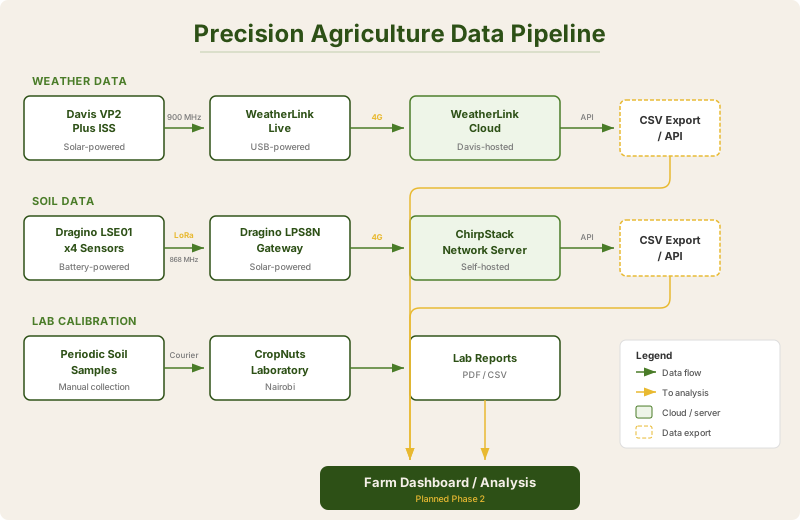
Click diagram to enlarge
Future Phases
Drone-based crop monitoring using a DJI Mavic 3 Multispectral — capable of NDVI mapping, crop stress detection, and field-level health assessment — and AI-assisted pest management are on our longer-term roadmap. At our current 6 acres, a handheld NDVI meter such as the Trimble GreenSeeker (~$500) would be far more cost-effective for vegetation health assessment; the drone makes economic sense at 50+ acres. It is also worth noting that commercial drone operations in Kenya require a KCAA Remote Operator Certificate (ROC), which currently carries a 6–12 month processing backlog — so licensing needs to start well before the equipment arrives. When we reach that stage, the approach will be the same: research the options, publish the costs, and document the results openly.
Data Strategy
How we collect, store, integrate, and share farm data. This section assembles our data strategy explicitly — it underpins every technology deployment on this page.
Data Model
Seven core entities: Field (6 acres, 2 blocks), Crop (per-season), Sensor (4x soil, 1x weather station), Reading (time-series at 5-min intervals for weather, 15-min for soil), Season, Harvest, and Cost. Every sensor reading is linked to its field block, crop, and season — so we can trace yield outcomes back to the conditions that produced them.
Integration
Weather data lives in WeatherLink Cloud (Davis REST API). Soil data lives in ChirpStack (self-hosted LoRaWAN network server). Lab results arrive from CropNuts as PDF or CSV. Phase 1: these systems run separately with manual CSV correlation. Phase 2: a unified dashboard correlating weather, soil moisture, and yield outcomes per field block.
Retention
WeatherLink Pro retains data in the Davis cloud for the duration of the subscription. ChirpStack data is stored locally on the gateway with periodic backup. All raw data is exported to CSV monthly and stored in a version-controlled repository. No data is siloed in a vendor platform without an export path.
Access
Farm data is published openly through journal entries and annual reports. Raw datasets are available on request to research and technology partners. Both Davis WeatherLink and ChirpStack provide REST APIs for programmatic access.
Calibration & Quality
Sensor readings are cross-referenced against CropNuts laboratory soil analysis. The weather station is calibrated against Davis factory specifications. Sensor drift is monitored by comparing adjacent sensor readings and flagging divergence greater than 15%.
Maintenance Plan
Coastal salt air, heat, and humidity accelerate equipment degradation. This plan keeps our monitoring infrastructure reliable.
| Component | Task | Frequency | Est. Cost | Responsible |
|---|---|---|---|---|
| Davis VP2 Plus ISS | Inspect radiation shield, clean rain gauge funnel | Monthly | — | Farm caretaker |
| Davis VP2 Plus ISS | Replace temperature/humidity board | 18 months | ~KES 5,200 | Founder |
| WeatherLink Live | Check 4G signal, verify data upload | Weekly | — | Farm caretaker |
| Dragino LSE01 sensors (×4) | Visual inspection, check probe seating | Monthly | — | Farm caretaker |
| Dragino LSE01 sensors (×4) | Battery replacement (all units) | 5–7 years | ~KES 2,500/unit | Founder |
| LPS8N Gateway | Clean solar panel, check battery voltage | Monthly | — | Farm caretaker |
| LPS8N Gateway | Replace solar battery | 2–3 years | ~KES 3,000 | Founder |
| All outdoor connectors | Apply marine-grade dielectric grease | 6 months | ~KES 500 | Founder |
| CropNuts soil analysis | Collect and ship composite samples | Per season | KES 8,000–15,000 | Founder |
| Mounting hardware | Inspect for corrosion, treat/replace | 6 months | ~KES 1,000 | Founder |
Get in Touch
Whether you manufacture sensors, run agricultural research, or fund early-stage farming projects — if this resonates, we would like to hear from you.